
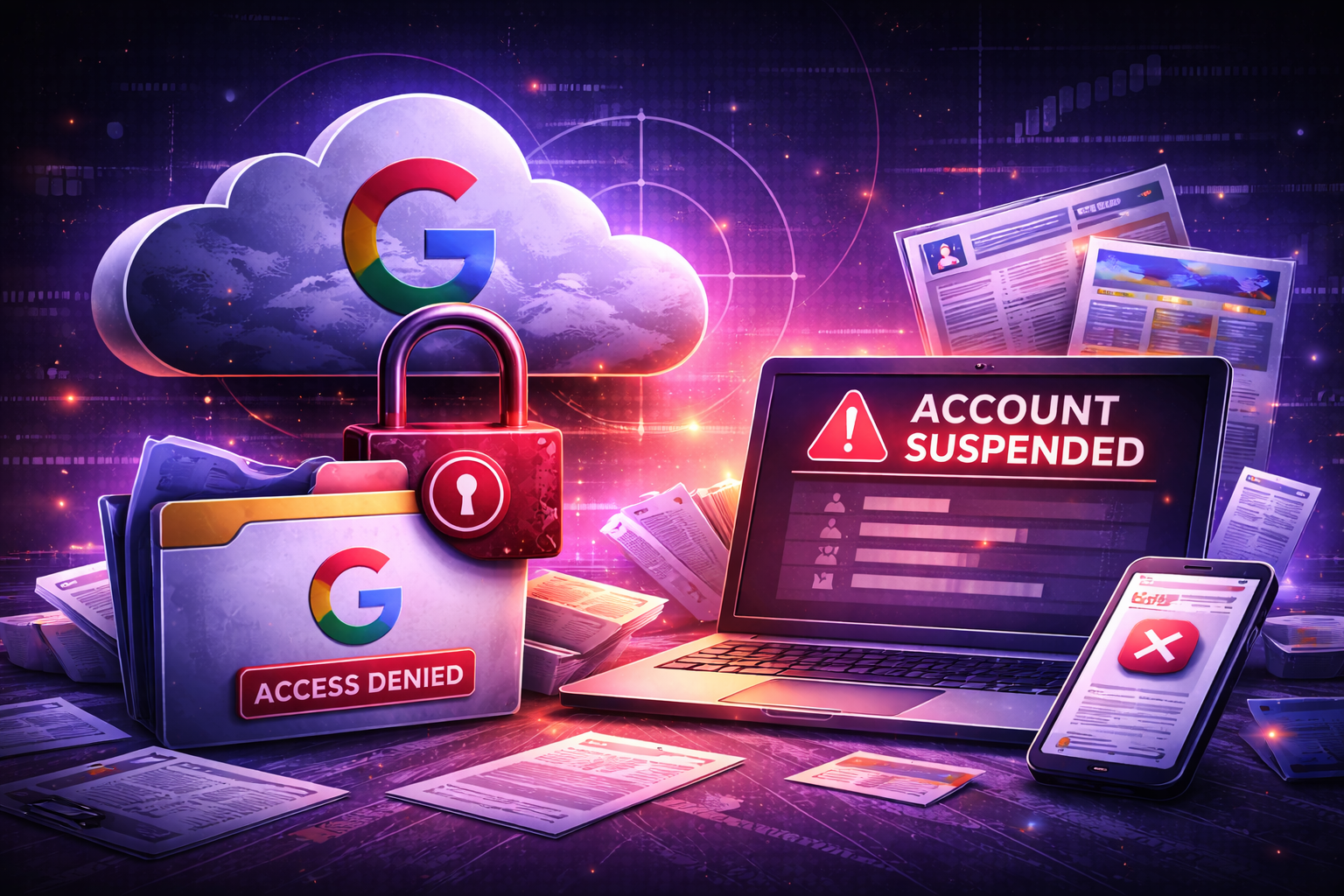
Cloud Storage Account Banned – Data Lost Due to Automated Enforcement
A neutral case study of an automated content-policy enforcement error that led to a permanent cloud account ban, total service lockout, and effectively unrecoverable personal data.
In early 2021, a Google cloud storage user experienced a sudden and complete loss of access to his account due to an automated content policy enforcement. The user, identified only as “Mark,” was a father who had taken photos of his toddler’s inflamed groin at a doctor’s request for diagnosis. These images were automatically backed up to Mark’s Google Photos/Drive cloud storage. Google’s systems – which scan user uploads for prohibited content – erroneously flagged the medical photos as child sexual abuse material (CSAM). Within two days, Google disabled Mark’s entire Google account, including Gmail, Google Drive/Photos, and even his Google Fi phone service, citing “harmful content” that was a severe policy violation. This incident became a high-profile example of a cloud storage account banned data lost scenario, as Mark was immediately cut off from all files and services tied to his Google account.
Timeline of Events
- February 2021: Mark takes the medical photos of his child, which are uploaded via Google’s cloud backup. The images are automatically scanned by Google’s content detection algorithms.
- Within 48 Hours: Google’s system flags the images as CSAM. Account Suspension: Approximately two days after the upload, Mark receives a notification that his Google account was disabled for “harmful content” – a severe violation of Google’s policies, potentially illegal. All Google services under his login (email, cloud storage, etc.) are locked down.
- Immediate Enforcement Actions: In line with legal obligations, Google files a report with the National Center for Missing and Exploited Children (NCMEC) and a police investigation is initiated without informing Mark beforehand. The San Francisco Police Department opens a case, and Google’s internal team also conducts a review of Mark’s account. Notably, Google employees proceeded to examine all of his cloud photos and videos (beyond the originally flagged images) as part of an internal investigation.
- Police Clearance: After review, law enforcement determines no crime occurred – the images were indeed medical in nature and not abusive. The SFPD cleared Mark of any wrongdoing in relatively short order.
- Appeal Attempt: Mark attempts to appeal the account ban through Google’s prescribed process. He provided documentation from the police showing that authorities found “no crime committed.” Google’s Response: A few days after his appeal submission, Google replied that it would not reinstate the account, offering no further explanation or avenue for recourse. The company stood by its decision to terminate the account despite the official clearance.
- August 2022 – Public Disclosure: Mark’s story became public when it was reported by The New York Times (later summarized by outlets like The Guardian and EFF). Even after media inquiries made the false positive evident, Google continued to refuse restoring Mark’s access. Over a year after the incident, the account remained permanently disabled.
- Outcome: As of the last reports, Mark’s Google account was not reinstated. His data stored on Google’s cloud – including over a decade of emails, contacts, photos, and videos – remained inaccessible and effectively lost to him. The only preserved copies of some of his files were those turned over to police during the investigation.
What Triggered Enforcement
Automated Content Scanning: The enforcement was triggered by Google’s automated content-matching systems. Tech companies like Google and Microsoft employ hash-matching databases and artificial intelligence to detect known or suspected CSAM in user uploads. In this case, Google’s AI misidentified a child’s medical photograph as illicit content. The detection process is largely automated – files are scanned upon upload, and any match to banned content or patterns flags the account for action. Google’s protocols in CSAM cases are stringent: once flagged, the content is reported to NCMEC as required by U.S. law and the user’s account is immediately frozen for further review.
Lack of Context: The trigger was purely based on the image content, without contextual understanding. As privacy technologists have noted, these algorithms “have access to a tremendously invasive amount of data about people’s lives” but lack context for that data. In Mark’s situation, an AI saw a nude child image and categorically treated it as abuse material, not recognizing the medical scenario. Google did involve human reviewers after the initial AI flag – however, those reviewers, while trained to recognize medical issues in photos, were not medical experts and did not consult medical professionals in each case. The result was that the human oversight failed to overturn the false positive. Google’s team ultimately concurred with the AI’s assessment, triggering account termination.
Immediate Reporting and Account Lock: Per company policy and federal law, once the content was flagged as CSAM, Google promptly filed a CyberTipline report and locked the account before notifying the user. The user was not alerted or asked for clarification prior to enforcement – instead, the process is procedural and automated to prevent any further distribution of the suspected content. This automated enforcement mechanism acts quickly: in Mark’s case, the gap between upload and account ban was only two days. No preliminary warning was given to the user about the specific violation; the first indication was the account already being disabled.
It’s important to note that such enforcement is not unique to Google. Other cloud providers have similar automated systems. For example, Microsoft’s OneDrive uses PhotoDNA (an image-hashing technology) to scan for CSAM across user files. If a match is found, Microsoft’s system automatically locks the account and all associated services and generates a NCMEC report, with a human reviewer quickly confirming the content before permanent suspension. In all cases, the trigger is a violation detected by automated tools, aiming to protect the platform and comply with the law – but these tools can and do misidentify content in rare instances.
Scope of Access Loss and Data Impact
When Mark’s Google account was terminated, the scope of loss extended far beyond the single flagged photo. Google’s services are deeply integrated under one account login, so the enforcement resulted in total account lockout. Mark lost access to: Gmail (his entire email history), Google Drive and Google Photos (all documents, pictures, and videos stored over the years), contacts, Google Calendar, and even his cellular service through Google Fi. In effect, years of personal data and digital records were rendered inaccessible overnight. Google’s decision was final – they “permanently deleted his account” despite police confirmation of his innocence. All content in cloud storage became unavailable, and presumably subject to deletion according to Google’s data retention policies for terminated accounts.
The data impact for Mark was catastrophic. As the Electronic Frontier Foundation summarized, Google’s actions “destroy[ed] without warning and without due process” a range of his digital assets – including his emails, family photos and videos, and even critical services tied to the account. No mechanism was provided for him to retrieve non-offending files. Data recovery was effectively impossible in this scenario. Google did not offer Mark any assistance in getting his files back; even after the mistake was acknowledged publicly, the company did not restore his data or account access. From Mark’s perspective, everything stored in the cloud was simply gone. (In fact, the only copies of some items, like the photos in question, resided with law enforcement after being submitted as part of the investigation.)
This case highlights the stakes of an account ban: a cloud storage ban means losing all content tied to that account. Another example underscores this impact – a Microsoft OneDrive user reported that after an abrupt account suspension, they lost “30 years’ worth of irreplaceable photos and work” stored online. Because that user had placed all data in one cloud basket, the account lock left them with nothing accessible. They received no prior warning and only generic explanations from the provider. In Mark’s Google case, the integrated nature of services meant even unrelated functions like phone service were cut off as collateral. The data loss was total, and it demonstrates how a single automated enforcement action can effectively wipe out a user’s digital life stored with a cloud provider.
What Users Could Not Control
Mark’s experience, and others like it, reveal several aspects that were outside the user’s control. First, the content scanning was not optional – by using the cloud service, users inherently agree to automated scans for policy violations. There was no way for Mark to prevent or opt out of Google’s AI reviewing his private uploads; it’s a built-in service mechanism. Users typically cannot disable these scans, as they are enforced uniformly to maintain the provider’s content standards and legal compliance. In practical terms, this means once Mark took those photos and they were backed up to the cloud, the outcome was out of his hands.
Secondly, the lack of context and communication left the user powerless. Mark was not notified during the process of flagging or given a chance to explain the situation before the ban. The enforcement was executed without his input. In the aftermath, his attempt to appeal was met with silence and a flat denial. Google did not provide an avenue for a real-time conversation or a nuanced review despite evidence in his favor. This reflects a general issue users face: there is often no easy way to get a human reviewer on the other side in such cases. As one observer noted, if a big provider like Google accuses you of something and blocks your account, “there is no easy way to get human support” to intervene. The process is largely one-sided.
Additionally, users might not even be aware of what content triggered the enforcement, especially if it was done automatically. In some cases, content can be synced or backed up without the user’s active involvement, leading to surprises. For instance, one OneDrive user speculated that an automatically saved image from a messaging app (content the user never knowingly handled) may have tripped Microsoft’s filters. That user had auto-backup enabled for WhatsApp/Telegram, meaning any image (even something illicit posted by someone else in a group chat) could have been saved to the cloud without explicit consent, potentially resulting in a ban. In such scenarios, users have practically no control – they neither intentionally uploaded disallowed content nor had awareness of its presence, yet they suffer the consequences of the platform’s automated sweep.
No Control over Scope of Enforcement: Once the account was flagged, Mark could not control the breadth of Google’s response. The company chose to lock everything and even inspect all his other files for additional violations. This “guilty until proven innocent” approach meant he couldn’t limit the investigation or protect the rest of his data from scrutiny or suspension. Users in cloud ecosystems cannot pick which parts of an account get restricted; it’s usually all or nothing, as dictated by provider policy.
Finally, the appeal and recovery process was largely out of the user’s hands. Mark did what he could – he filed an appeal and presented evidence – but he had no influence on whether Google’s internal team would reconsider. In his case, they did not. Similarly, other users report sending dozens of appeal requests or compliance forms with no human response, describing the experience as a “Kafkaesque black hole” of automated replies. In summary, users like Mark have no control over the automated enforcement triggers, no say in the immediate account lock actions, and very limited ability to reverse the decision or retrieve their data after the fact.
Structural Implications
This incident underscores structural implications for cloud storage services and their users. Centralized cloud platforms act as custodians of user data – and simultaneously as enforcers of content policies. This dual role means that when an automated system identifies a violation, the provider can unilaterally sever a user’s access to all their information. The structure of unified accounts (as seen with Google’s one-account-for-everything model or Microsoft’s linked services) creates a single point of failure: if the account is banned, every service under that login is affected. Users like Mark effectively entrust their digital lives to the platform, so an erroneous ban can have far-reaching impact. One commentator noted that relying on one company for all personal data is risky – “no 1 company can ruin my life at the flick of a switch”, he remarked, emphasizing efforts to avoid a single point of failure. Mark’s case showed how, indeed, one switch flipped by an algorithm completely derailed his digital access.
From a procedural standpoint, the case illustrates the tension between safety automation and user rights. Cloud providers are structurally inclined to err on the side of caution when policing content – the systems are set to over-block rather than risk allowing harmful material. However, the lack of a robust secondary review or due process for the user is a structural shortcoming. The enforcement mechanism operated as designed, but it provided no accommodation for context or error correction in this instance. Experts have pointed out that these systems can cause real harm through false positives, and the consequences for users are not trivial. Innocent users can be “swept up” by automated rules that treat them as offenders, with little recourse. Structurally, the case highlights that providers have near-total authority over user data stored on their servers – data which can be rendered inaccessible at a moment’s notice, without external oversight or a neutral arbitration before action. While users technically agree to terms that allow such enforcement, the expectation of seamless service leads many to underestimate this latent risk.
The incident also has raised awareness that automated enforcement at scale can fail in edge cases. It poses questions about reliability and trust in cloud services. If a family’s treasured photos or a person’s business documents can disappear due to an algorithm’s mistake, confidence in the infallibility of cloud storage is shaken. It’s a neutral fact that companies must balance broad protection measures with the possibility of mistakes. Here, the structural emphasis on automation and compliance (to combat CSAM, which is unquestionably important) came at the cost of an individual’s data rights. That trade-off is increasingly being scrutinized. Nonetheless, providers appear to consider such strict enforcement necessary – Google’s stance in Mark’s case was that it would “stand by its decision” to ban the account, even when the error was clear. The structure of policy is such that false positives are treated as acceptable collateral damage in the eyes of the system, in order to achieve overall safety goals. This raises broader, neutral questions about whether users should diversify their data storage or push for better safeguards within these platforms.
Architectural Alternatives
Given the risks illuminated by this case, some architectural alternatives could mitigate similar outcomes. One approach is to remove the cloud provider’s ability to inspect user data altogether – in other words, employ end-to-end encryption or zero-knowledge storage. In a zero-knowledge cloud storage design, the service provider cannot read the contents of files; only the user holds the keys to decrypt data. For example, LockItVault is a cloud storage service that advertises a “zero knowledge” architecture, meaning no third-party (not even the provider) can access or scan the unencrypted data. In such a model, automated content enforcement by the provider is essentially impossible, because the provider’s systems do not see the actual content. This protects users from false positives by design, though it also means illegal material could go undetected – a trade-off that shifts responsibility entirely to users. Other privacy-focused storage solutions and personal encryption tools similarly ensure that only the user controls their data, potentially preventing unwarranted account bans at the cost of forgoing server-side safety scans.
Another alternative architecture is a decentralized or self-hosted storage solution. Instead of placing all data under one big tech provider, a user could use a personal server or a federated cloud service. This way, there isn’t a single corporate algorithm scanning all files or a single corporate account that, if closed, would lock away everything. For instance, running a private NAS or using open-source cloud software (like Nextcloud) gives the user full control over content and access policies. However, these approaches require more technical overhead and lack the seamless convenience of big providers. They also shift security responsibilities to the user.
On the user side, a practical safeguard that emerges from these incidents is adhering to the 3-2-1 backup rule (keep multiple copies of data on different mediums). Relying exclusively on any one cloud account is risky. Architecturally, even within existing services, a user can choose to locally encrypt sensitive files before uploading them (using third-party encryption tools), or avoid syncing certain personal media to cloud libraries that are known to be scanned. While such measures may be cumbersome, they represent ways to retain control. In summary, alternatives like client-side encryption, zero-knowledge cloud storage, or hybrid backup strategies can provide a buffer against the kind of total data loss Mark experienced, by either technically preventing provider intervention or ensuring redundant copies of data under the user’s direct control.
Conclusion
The case of Mark’s Google account exemplifies what can happen when automated enforcement mechanisms collide with the realities of personal data storage in the cloud. A photo taken for legitimate reasons was misclassified by an algorithm, leading to a cascade of enforcement actions that resulted in a permanent account ban and irretrievable data loss. The timeline showed a rapid escalation – from upload to account termination – with minimal opportunity for the user to intervene. The enforcement trigger (an AI-driven content filter) operated as designed procedurally, yet it yielded a profoundly unjust outcome for the individual. Crucially, the provider’s appeal and review processes offered no relief in this instance: the user’s attempts to contest the decision were met with automated responses and ultimately a firm refusal to restore access. Data recovery proved impossible, illustrating that when a cloud storage account is banned under such terms, the user may lose all stored data with no recourse.
This incident has shed light on the inherent risks of entrusting vast amounts of personal or business data to cloud platforms without backups or guarantees. It remains a strictly factual example of how a cloud storage account banned for a false violation can leave a user with data lost irreversibly. Users and companies alike are learning from these episodes – some users are now more cautious about what they upload to cloud services, and there are calls for providers to refine their review mechanisms to better handle false positives. At the same time, the case underscores why cloud providers enforce strict policies: they are combating real abuse and following legal mandates, albeit with blunt tools. Going forward, a neutral takeaway is that those who use cloud storage should be aware of the procedural enforcement architecture in place. Understanding that an automated system can, in rare cases, wrongly ban an account helps users make informed choices about backups and alternative safeguards. The cloud offers immense convenience, but as this example shows, it also introduces a structural dependency on the provider’s judgment. In the balance between protecting society and preserving individual users’ data, Mark’s story highlights a gap – one that might be addressed by improved human oversight, more transparent appeal processes, or new cloud architectures that give users greater control.
Disclaimer
This article is intended for informational purposes only, documenting a real case and its implications in a neutral manner. It is not legal advice or an indictment of any particular company. All information cited is from reputable sources, and no endorsements of any products or services (including those mentioned as alternatives) are implied. The focus has been on factual analysis of a cloud storage account ban leading to data loss. Individual experiences may vary, and readers should consider their own data backup and security practices accordingly.